
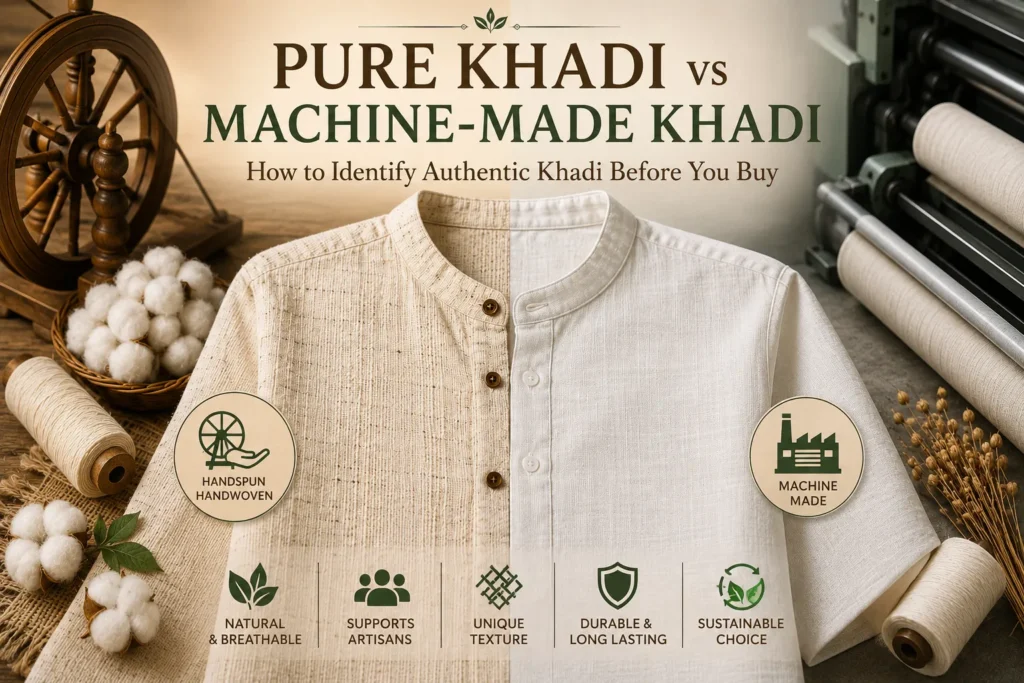
Buying Khadi has become easier than ever. Today, you can find Khadi shirts, kurtas, sarees, and dresses in local stores and online marketplaces. However, there is one challenge many buyers face—not every fabric sold as “Khadi” is truly authentic.
Many products look like Khadi but are made using machines instead of traditional hand-spinning and hand-weaving techniques. At first glance, they may appear similar, but their quality, texture, durability, and craftsmanship are very different. Without knowing these differences, buyers often end up paying for a product that does not offer the true comfort and heritage of genuine Khadi.
If you are shopping for Khadi for the first time, learning how to identify authentic fabric can save you money and help you make a better purchase. Whether you are looking for everyday clothing, office wear, wedding attire, or sustainable fashion, understanding what makes Pure Khadi unique is an important first step.
In this guide, you will learn:
- What Pure Khadi really is
- How Machine-Made Khadi is produced
- The key differences between the two
- Simple ways to identify authentic Khadi before buying
- Why genuine Khadi offers better long-term value
- How choosing authentic Khadi supports traditional artisans and sustainable fashion
By the end of this article, you will know exactly what to look for when buying Khadi and feel confident choosing clothing that reflects quality, craftsmanship, and tradition.
What Is Pure Khadi?
Pure Khadi is a handcrafted fabric made through two traditional processes: hand spinning and hand weaving. Every stage of production depends on skilled artisans rather than industrial machines. This slow and careful method gives Khadi its unique texture, breathability, and character.
Unlike mass-produced fabrics, Pure Khadi is not created in large factories. It begins with natural fibres such as cotton, silk, or wool. These fibres are spun into yarn using a traditional spinning wheel, known as the Charkha. The yarn is then woven by hand on a loom to create fabric that is both durable and comfortable.
Because every thread is handled by artisans, no two pieces of Pure Khadi are exactly alike. Small variations in the weave are natural and are considered a mark of authenticity rather than a defect.
The Traditional Process Behind Pure Khadi
Creating Pure Khadi takes time, patience, and skill. Each step contributes to the fabric’s distinctive quality.
Hand Spinning
The journey begins with natural fibres that are spun into yarn by hand. This process produces yarn with slight natural variations, giving the finished fabric its characteristic texture.
Hand Weaving
After spinning, the yarn is woven manually on a handloom. Skilled weavers carefully interlace each thread, creating a breathable fabric that feels comfortable in different weather conditions.
Natural Finishing
Pure Khadi often undergoes minimal chemical processing. This helps preserve the softness of natural fibres while reducing the environmental impact of production.
Why Pure Khadi Is Different
Many fabrics focus only on appearance. Pure Khadi offers much more than that. It combines comfort, sustainability, craftsmanship, and cultural heritage in one fabric.
Excellent Breathability
The handwoven structure allows better air circulation than many machine-made fabrics. This makes Pure Khadi especially comfortable in Kerala’s warm and humid climate.
Comfortable Throughout the Year
Pure Khadi adapts well to changing weather. It feels cool during summer and provides gentle warmth during cooler months, making it suitable for year-round wear.
Becomes Softer With Every Wash
Unlike many synthetic fabrics that lose their quality over time, genuine Khadi becomes softer with regular use while maintaining its strength.
Every Piece Is Unique
Machine-made fabrics aim for perfect uniformity. Pure Khadi celebrates the beauty of handcrafted work. Small irregularities in the weave reflect the artisan’s craftsmanship and make each garment unique.
Supports Rural Artisans
Choosing authentic Khadi directly supports skilled artisans and weaving communities who preserve traditional techniques passed down through generations. Every purchase helps sustain rural livelihoods and keeps this heritage alive.
A Sustainable Choice
Pure Khadi requires less energy during production because it relies on manual craftsmanship rather than large industrial machinery. This makes it one of the most environmentally friendly textile choices available today.
Why Pure Khadi Has Become Popular Again
In recent years, more people have started choosing natural and sustainable clothing over fast fashion. Consumers are looking beyond trends and paying closer attention to how their clothes are made.
Pure Khadi meets many of these expectations. It is breathable, durable, environmentally responsible, and timeless in style. Young professionals, students, entrepreneurs, and even fashion designers are embracing Khadi not just for its traditional value but also for its versatility in modern wardrobes.
From casual shirts and office wear to elegant sarees and wedding collections, Pure Khadi has evolved into a fabric that suits both traditional and contemporary lifestyles.
Most importantly, buying authentic Khadi is not simply purchasing clothing—it is investing in craftsmanship, supporting artisan communities, and preserving one of India’s most celebrated textile traditions.
What Is Machine-Made Khadi?
As the demand for Khadi has grown, many manufacturers have introduced fabrics that resemble traditional Khadi but are produced using industrial machines. These fabrics are commonly marketed as “Khadi-style,” “Khadi cotton,” or simply “Khadi,” even though they do not follow the traditional hand-spinning and hand-weaving process.
This has created confusion among buyers. While machine-made Khadi may look similar from a distance, it differs significantly in craftsmanship, texture, sustainability, and authenticity.
Understanding how machine-made fabric is produced will help you make an informed purchase and avoid confusing appearance with authenticity.
How Machine-Made Khadi Is Produced
Unlike Pure Khadi, machine-made fabric relies on automated textile manufacturing. The process is designed to produce large quantities quickly and at a lower cost.
The production usually follows these steps:
- Machine-Spun Yarn Cotton fibres are spun into perfectly uniform yarn using high-speed industrial machines. Unlike hand-spun yarn, the threads have a consistent thickness with almost no natural variations.
- Power Loom Weaving The yarn is woven on power looms that can produce thousands of metres of fabric in a short period. This results in a smooth, even weave that lacks the distinctive handcrafted character of Pure Khadi.
- Chemical Processing and Finishing Many machine-made fabrics undergo chemical treatments to improve softness, reduce wrinkles, enhance colour retention, or create a polished appearance. While these finishes may improve visual appeal, they can reduce the natural feel and breathability associated with authentic Khadi.
The result is a fabric that is affordable and consistent but does not reflect the traditional craftsmanship behind genuine Khadi.
Why Machine-Made Khadi Looks Similar
One of the biggest reasons buyers get confused is that machine-made fabrics are designed to imitate the appearance of handwoven Khadi.
Manufacturers often use textured weaving patterns or special finishing techniques to create a similar visual effect. To someone unfamiliar with genuine Khadi, both fabrics may appear almost identical.
However, once you look closely or wear the fabric, the differences become much more noticeable.
For example:
- Machine-made fabric usually has a perfectly uniform weave.
- The texture feels smoother and more consistent.
- The fabric lacks the subtle irregularities found in handcrafted Khadi.
- It may not become softer with repeated washing in the same way Pure Khadi does.
These differences are not flaws—they are simply the result of two completely different manufacturing methods.
Can Machine-Made Fabric Be Called Khadi?
This is one of the most common questions among buyers.
The answer is not always.
Traditionally, Khadi is defined as fabric that is both hand-spun and handwoven. If either of these processes is replaced by industrial machinery, the fabric does not meet the traditional definition of Pure Khadi.
However, in the retail market, terms such as “Khadi cotton,” “Khadi blend,” or “Khadi-look fabric” are often used for products that only resemble Khadi in appearance. While these fabrics may be suitable for everyday use, they should not be mistaken for authentic handcrafted Khadi.
This is why reading product descriptions carefully and purchasing from trusted brands is so important.
Advantages of Machine-Made Khadi
Machine-made fabrics are not inherently bad. In fact, they offer several practical benefits depending on the buyer’s needs.
Some advantages include:
- Lower price compared to handcrafted Khadi.
- Widely available in retail stores and online marketplaces.
- Consistent texture and finish.
- Faster production allows for greater variety in colours and designs.
- Easier to manufacture in large quantities.
For budget-conscious shoppers or those looking for everyday clothing, machine-made fabrics can still be a reasonable option.
Limitations of Machine-Made Khadi
Although machine-made fabric has its advantages, it cannot fully replicate the qualities that make Pure Khadi special.
Some key limitations include:
- Does not support traditional hand-spinning and hand-weaving communities.
- Lacks the unique handcrafted texture of authentic Khadi.
- Often less breathable than genuine handwoven fabric.
- Does not carry the same cultural and historical significance.
- May involve higher energy consumption during manufacturing.
- Offers a more uniform appearance, missing the individuality of handcrafted textiles.
For buyers who value craftsmanship, sustainability, and authenticity, these differences can play a major role in their purchasing decision.
Why Knowing the Difference Matters
Choosing between Pure Khadi and machine-made fabric is about more than comparing two textiles. It is about understanding what you are paying for.
If your priority is affordability and convenience, machine-made fabric may meet your needs.
If you are looking for a garment that reflects traditional craftsmanship, supports skilled artisans, offers exceptional comfort, and represents sustainable fashion, Pure Khadi is the better choice.
By learning how these fabrics are made, you can shop with confidence and ensure that the product you purchase matches your expectations.
Pure Khadi vs Machine-Made Khadi: A Complete Comparison
At first glance, Pure Khadi and machine-made Khadi may look almost identical. Both are available in similar colours, patterns, and clothing styles. However, the real difference lies in how the fabric is made, how it feels, how long it lasts, and the value it offers over time.
The table below highlights the key differences to help you make an informed buying decision.
| Feature | Pure Khadi | Machine-Made Khadi |
|---|---|---|
| Production Method | Hand-spun and handwoven by skilled artisans | Machine-spun and machine-woven in textile mills |
| Yarn Quality | Naturally uneven with unique character | Uniform and perfectly consistent |
| Fabric Texture | Rich, soft, and slightly irregular | Smooth, even, and factory-finished |
| Appearance | Every piece is unique | All pieces look almost identical |
| Breathability | Excellent airflow, ideal for hot climates | Good, but generally less breathable |
| Comfort | Becomes softer with every wash | Soft initially but changes little over time |
| Durability | Highly durable with proper care | Durable but depends on manufacturing quality |
| Environmental Impact | Low-energy production with a smaller carbon footprint | Higher energy consumption due to industrial production |
| Support for Artisans | Directly supports traditional weaving communities | Limited involvement of traditional artisans |
| Price | Higher because of skilled manual craftsmanship | More affordable due to mass production |
| Production Speed | Slow and labour-intensive | Fast and suitable for large-scale manufacturing |
| Authenticity | Genuine handcrafted Khadi | Khadi-inspired fabric or machine-produced textile |
Understanding the Key Differences
A comparison table provides a quick overview, but understanding why these differences matter will help you choose the right fabric for your needs.
1. Craftsmanship
The biggest difference between the two fabrics is the level of craftsmanship involved.
Pure Khadi is created by artisans who spend hours spinning yarn by hand and weaving it on traditional looms. Every metre of fabric reflects their experience, patience, and skill.
Machine-made fabric, on the other hand, is produced using automated equipment designed for speed and consistency. While efficient, it cannot replicate the human touch that makes authentic Khadi unique.
Winner: Pure Khadi
2. Comfort in Kerala’s Climate
Kerala experiences warm temperatures and high humidity for most of the year. Choosing a breathable fabric is essential for staying comfortable.
Pure Khadi has a naturally open weave that allows better air circulation. It absorbs moisture efficiently and feels light even during hot summer days.
Machine-made fabrics can also be comfortable, but their tighter weave often traps more heat and reduces airflow compared to handwoven Khadi.
If you are looking for clothing suitable for Kerala’s climate, Pure Khadi is generally the better choice.
Winner: Pure Khadi
3. Texture and Feel
One of the easiest ways to identify authentic Khadi is by touching the fabric.
Pure Khadi has a soft, natural texture with slight irregularities. These variations are not defects—they are evidence of hand spinning and hand weaving.
Machine-made fabric feels more uniform and polished because every thread is produced with identical thickness.
Over time, Pure Khadi becomes even softer without losing its strength, making it more comfortable with regular use.
Winner: Pure Khadi
4. Durability
Many people assume that handmade fabric is delicate, but the opposite is often true.
When cared for properly, Pure Khadi can last for many years. Its strong natural fibres and careful weaving make it highly durable.
Machine-made fabric is also durable, but its lifespan depends on the quality of the yarn, manufacturing process, and finishing treatments.
A well-maintained Pure Khadi shirt or kurta often retains its quality longer than many mass-produced garments.
Winner: Pure Khadi
5. Sustainability
One of the greatest strengths of Pure Khadi is its environmentally friendly production process.
Since it relies on manual spinning and weaving, it consumes significantly less energy than industrial textile manufacturing. It also supports slower, more responsible production practices.
Machine-made fabrics require electricity-powered machinery and large-scale manufacturing processes, resulting in a higher environmental impact.
For buyers who value sustainable fashion, Pure Khadi is the clear choice.
Winner: Pure Khadi
6. Price and Value
Machine-made fabric is usually less expensive because it can be produced quickly and in large quantities.
Pure Khadi costs more because every stage of production requires skilled manual labour. While the initial price may be higher, many buyers find that its durability, comfort, and timeless appeal provide better long-term value.
Instead of focusing only on the purchase price, it is worth considering how long the garment will last and the experience it offers.
Winner: Depends on Your Priority
- Budget-conscious buyers: Machine-Made Khadi
- Quality-conscious buyers: Pure Khadi
7. Cultural and Emotional Value
Clothing is not always just about fashion—it can also reflect tradition and craftsmanship.
Every piece of Pure Khadi represents the work of artisans who preserve centuries-old weaving techniques. Choosing authentic Khadi helps keep these traditions alive and supports rural communities across India.
Machine-made fabrics provide convenience and affordability, but they do not carry the same cultural significance or handcrafted heritage.
If preserving traditional craftsmanship matters to you, Pure Khadi offers far greater value than what can be measured by price alone.
Winner: Pure Khadi
Which One Should You Choose?
The right choice depends on your needs and expectations.
Choose Machine-Made Khadi if you:
- Have a limited budget.
- Need affordable everyday clothing.
- Prefer a perfectly uniform appearance.
- Want easy availability in a wide range of designs.
Choose Pure Khadi if you:
- Value authentic craftsmanship.
- Prefer natural and breathable fabrics.
- Want clothing that becomes softer over time.
- Support sustainable and ethical fashion.
- Appreciate traditional Indian weaving techniques.
- Are looking for premium-quality garments that last for years.
For many buyers, Pure Khadi is more than a fabric—it is a long-term investment in comfort, quality, and heritage.
9 Easy Ways to Identify Pure Khadi Before You Buy
Buying authentic Khadi can feel challenging, especially when many products in the market use terms like “Khadi Cotton,” “Khadi Blend,” or “Handloom Style.” While these fabrics may resemble Khadi, they are not always made using the traditional hand-spinning and hand-weaving process.
The good news is that you do not need to be a textile expert to identify genuine Khadi. By paying attention to a few important details, you can confidently distinguish authentic handcrafted fabric from machine-made alternatives.
Here are nine practical ways to identify Pure Khadi before making a purchase.
1. Feel the Texture Carefully
The simplest test begins with your hands.
Pure Khadi does not feel perfectly smooth like most machine-made fabrics. Instead, it has a soft, natural texture with slight irregularities that reflect the handcrafted weaving process.
These subtle variations are a sign of authenticity, not poor quality.
Machine-made fabrics usually feel overly smooth and perfectly uniform because every thread is produced by automated machinery.
Quick Tip:
If the fabric feels too perfect, it is worth examining more closely.
2. Look Closely at the Weave
Authentic Khadi is woven by hand, which creates tiny natural variations in the weaving pattern.
These small differences make every piece of fabric unique. They should not be mistaken for manufacturing defects.
Machine-made fabrics have a perfectly consistent weave because power looms maintain identical spacing throughout the entire fabric.
What to Look For:
✔ Slight variations in thread spacing
✔ Natural handcrafted appearance
✔ No repetitive machine-like pattern
3. Check for Natural Slubs
One of the easiest ways to identify Pure Khadi is by looking for slubs.
Slubs are small, uneven thick or thin sections in the yarn that occur naturally during hand spinning.
These irregularities are one of the strongest indicators that the fabric has been handcrafted.
Machine-made yarn is highly uniform and usually lacks these natural characteristics.
Remember:
Natural slubs are a feature of authentic Khadi—not a flaw.
4. Observe the Fabric’s Appearance
Pure Khadi has a distinctive visual character.
Instead of looking factory-perfect, it has a slightly organic appearance that reflects the artisan’s work.
When you compare two authentic Khadi garments, you may notice minor differences in texture or weave. This individuality is part of what makes handcrafted clothing special.
Machine-made fabrics tend to look identical because every metre is produced under controlled industrial conditions.
5. Read the Product Description Carefully
When shopping online, never rely only on product images.
Always read the description to understand how the fabric was made.
Look for clear information such as:
- Hand-spun yarn
- Handwoven fabric
- 100% Pure Khadi
- Artisan-crafted
- Natural fibres
Be cautious if the description uses vague terms like:
- Khadi-inspired
- Khadi look
- Khadi blend
- Khadi cotton (without explaining the weaving process)
- Handloom-style fabric
Transparent brands clearly explain the origin and production of their products.
6. Check for Authentic Certification
One of the most reliable ways to verify genuine Khadi is to look for recognised certification or information about the source of the fabric.
Trusted sellers often provide details about:
- Where the fabric was woven
- Artisan communities involved
- Production methods
- Fabric composition
- Quality assurance
If this information is missing, consider asking the seller before making a purchase.
Reliable brands are usually happy to explain how their products are made.
7. Compare the Price Carefully
Price alone should never determine authenticity, but it can provide useful clues.
Pure Khadi requires:
- Skilled artisans
- Hand spinning
- Hand weaving
- Longer production time
- Careful finishing
Because of this, genuine Khadi generally costs more than mass-produced fabrics.
If a product is advertised as “Pure Handwoven Khadi” at an unusually low price, it is worth investigating further.
The goal is not to buy the cheapest fabric—it is to buy genuine value.
8. Ask Questions Before Buying
Whether you are shopping online or in a physical store, do not hesitate to ask questions.
Some useful questions include:
- Is the yarn hand-spun?
- Is the fabric handwoven?
- Where was it woven?
- Which natural fibre was used?
- Is this authentic Pure Khadi?
- How should I care for the garment?
A knowledgeable seller should be able to answer these questions confidently and transparently.
9. Buy From a Trusted Brand
Perhaps the easiest way to avoid confusion is to purchase from brands that specialise in authentic Khadi.
A trusted brand is transparent about:
- Fabric sourcing
- Production methods
- Quality standards
- Artisan involvement
- Product care
Instead of focusing only on price, look for brands that value craftsmanship, sustainability, and customer trust.
When you choose a reputable Khadi brand, you are not only buying clothing—you are investing in quality, supporting traditional artisans, and preserving India’s rich textile heritage.
Common Mistakes Buyers Make
Even experienced shoppers sometimes misunderstand what makes Khadi authentic. Avoid these common mistakes:
Buying Based Only on Appearance
A fabric may look like Khadi but still be completely machine-made. Always check how it was produced.
Assuming Every Product Labeled “Khadi” Is Authentic
Marketing terms can be misleading. Read the product description carefully and verify the production process.
Choosing the Lowest Price
Authentic craftsmanship takes time. If the price seems too good to be true, it often is.
Ignoring Product Details
A few extra minutes spent reading specifications or asking questions can help you avoid disappointment later.
Why These Identification Tips Matter
Learning how to identify Pure Khadi helps you make smarter purchasing decisions.
Instead of relying on labels alone, you can evaluate the fabric based on its texture, weave, craftsmanship, and transparency.
This knowledge ensures that the clothing you buy matches your expectations in terms of comfort, durability, authenticity, and value.
More importantly, every purchase of genuine Khadi helps sustain traditional weaving communities and encourages responsible fashion choices.
Why Pure Khadi Costs More Than Machine-Made Fabric
One of the most common questions buyers ask is:
“Why is Pure Khadi so expensive compared to machine-made fabric?”
At first glance, two shirts may look almost identical. One costs ₹700, while the other costs ₹1,800 or more. Many people assume they are paying only for a brand name, but the real difference lies in how the fabric is made and the value it delivers over time.
Pure Khadi is not expensive because it is fashionable—it costs more because it requires time, skill, craftsmanship, and human effort that machines cannot replace.
Let’s look at the factors that influence its price.
1. Every Metre Is Handcrafted
Unlike factory-made textiles, Pure Khadi is created almost entirely by human hands.
Before the fabric reaches a tailor or clothing brand, skilled artisans spend hours spinning yarn and weaving every metre on a handloom. This traditional process cannot be rushed without compromising quality.
Mass-produced fabrics can be manufactured in minutes, while authentic Khadi may take several days to complete.
When you buy Pure Khadi, you are paying for craftsmanship rather than mass production.
2. Skilled Artisans Make Every Piece
Producing authentic Khadi requires years of experience.
Hand spinning requires precision to create strong and balanced yarn. Hand weaving demands patience and consistency to produce fabric that is both comfortable and durable.
These skills are often passed down through generations of artisan families.
Every purchase of Pure Khadi helps preserve these traditional crafts and provides income for rural weaving communities.
3. Production Takes Much Longer
Time is one of the biggest reasons Pure Khadi costs more.
Machine-made fabric is designed for speed. Industrial looms can produce thousands of metres in a single day.
Handwoven Khadi follows a completely different approach.
A single artisan can produce only a limited amount of fabric in the same period because every movement is done manually.
This slower production process naturally increases the cost but also ensures greater attention to detail and quality.
4. Better Quality Requires Better Materials
Authentic Khadi is typically made from carefully selected natural fibres such as cotton, silk, or wool.
These fibres are chosen for their comfort, durability, and breathability.
Many inexpensive machine-made fabrics may include synthetic fibres or blends to reduce manufacturing costs.
While blended fabrics can be suitable for some purposes, they usually do not provide the same natural feel or long-term comfort as Pure Khadi.
5. Pure Khadi Lasts Longer
When evaluating clothing, it is important to consider cost per wear, not just the purchase price.
Imagine buying:
- A machine-made shirt that lasts two years.
- A well-maintained Pure Khadi shirt that lasts five years or more.
Although the initial investment is higher, the long-term value can be significantly better.
Many Khadi garments also improve with age, becoming softer and more comfortable after repeated washing.
A quality garment that lasts longer often proves to be the more economical choice over time.
6. Sustainable Production Has Value
Modern consumers are becoming more aware of how their clothing affects the environment.
Pure Khadi is one of the few fabrics that combines traditional craftsmanship with environmentally responsible production.
Since much of the work is done manually, the manufacturing process consumes considerably less electricity than large industrial textile mills.
Choosing authentic Khadi supports a slower, more sustainable approach to fashion that prioritises quality over quantity.
7. You Support Artisan Livelihoods
When you purchase authentic Khadi, your money supports far more than a piece of clothing.
It helps sustain:
- Rural weaving families
- Traditional spinning communities
- Handloom artisans
- Small-scale textile producers
- India’s rich weaving heritage
Instead of contributing only to industrial manufacturing, your purchase helps preserve centuries-old skills that might otherwise disappear.
For many buyers, this social impact is one of the most meaningful reasons to choose Pure Khadi.
Is Pure Khadi Worth the Higher Price?
For many people, the answer is yes.
The value of Pure Khadi goes beyond the fabric itself.
You receive:
- Exceptional breathability
- Long-lasting durability
- Timeless style
- Unique handcrafted character
- Greater comfort over time
- Sustainable production
- Support for traditional artisans
Rather than viewing Pure Khadi as an expensive purchase, it is better to think of it as an investment in quality, craftsmanship, and responsible fashion.
Is Machine-Made Fabric Always a Bad Choice?
Not at all.
Machine-made fabrics serve an important purpose and can be the right choice for many buyers.
They are ideal if you:
- Have a limited budget.
- Need clothing for everyday use.
- Prefer lower-cost options.
- Want a wide variety of colours and designs.
There is nothing wrong with choosing machine-made fabric if it meets your needs.
The key is knowing exactly what you are buying.
Problems arise only when machine-made fabrics are marketed as authentic handcrafted Khadi without clearly explaining how they were produced.
Transparency helps buyers make informed decisions and builds trust between brands and customers.
Pure Khadi Is More Than a Fabric
When you wear authentic Khadi, you are wearing something that carries a story.
It reflects the skill of artisans, the patience of hand weaving, the beauty of natural fibres, and the heritage of one of India’s most celebrated textiles.
Every slight variation in the weave reminds you that your garment was crafted by human hands—not mass-produced by machines.
That uniqueness is something no factory can truly replicate.
Why Khadigram Believes in Authentic Craftsmanship
At Khadigram, we believe clothing should offer more than style. It should provide comfort, quality, and a connection to the people who create it.
Our focus is on offering thoughtfully crafted Khadi apparel inspired by Kerala’s traditions while embracing modern design. From everyday shirts and kurtas to customised embroidery and wedding collections, we aim to create garments that celebrate authentic craftsmanship and timeless elegance.
When you choose Khadigram, you are choosing clothing designed to be worn, appreciated, and cherished for years—not just for a season.
Why Choosing Pure Khadi Matters
Choosing clothing is about more than selecting a colour or style. Every purchase reflects your priorities, whether that is comfort, quality, sustainability, or supporting traditional craftsmanship.
When you choose Pure Khadi, you are investing in a fabric that has stood the test of time. It is made with care, designed to last, and carries a story that no machine can reproduce.
In a world where fast fashion dominates the market, Pure Khadi offers a refreshing alternative—one that values people, craftsmanship, and responsible production.
A Fabric That Respects Tradition
Khadi is deeply connected to India’s cultural heritage. For generations, artisans have preserved the traditional techniques of hand spinning and hand weaving, creating fabrics that represent patience, skill, and dedication.
Every authentic Khadi garment reflects hours of careful work. The slight variations in the weave are reminders that the fabric was created by human hands, making each piece unique.
By choosing Pure Khadi, you help ensure that these traditional weaving skills continue to thrive for future generations.
Better for Everyday Comfort
One of the biggest reasons people continue to choose Khadi is its exceptional comfort.
Its breathable structure allows air to circulate freely, helping you stay cool in warm weather while remaining comfortable throughout the year. As the fabric ages, it becomes softer without losing its strength.
Whether you are attending work, travelling, celebrating a festival, or simply enjoying a casual day out, Pure Khadi offers a level of comfort that improves with time.
A Sustainable Fashion Choice
The fashion industry is one of the world’s largest consumers of natural resources. As awareness of environmental issues grows, more people are looking for clothing that is produced responsibly.
Pure Khadi supports this shift by relying on traditional craftsmanship instead of energy-intensive industrial production. It promotes slower manufacturing, reduces unnecessary waste, and encourages mindful consumption.
Choosing fewer, higher-quality garments that last longer is one of the simplest ways to build a more sustainable wardrobe.
Supporting Skilled Artisans
Behind every piece of Pure Khadi is a community of skilled artisans whose expertise has been developed over many years.
Your purchase contributes to:
- Preserving traditional weaving techniques.
- Supporting rural employment opportunities.
- Encouraging fair craftsmanship.
- Keeping India’s rich textile heritage alive.
When you wear authentic Khadi, you become part of this larger story of preserving craftsmanship and empowering artisan communities.
Why Buy Authentic Khadi from Khadigram?
At Khadigram, we believe authentic Khadi should combine tradition with modern style.
Our collections are thoughtfully designed for people who appreciate natural fabrics, timeless craftsmanship, and comfortable clothing that suits Kerala’s lifestyle.
Whether you are looking for:
- Premium Khadi shirts
- Elegant kurtas
- Traditional Kerala wear
- Wedding collections
- Custom embroidery
- Everyday handcrafted clothing
our goal is to offer products that celebrate the true spirit of Khadi while meeting the needs of today’s customers.
We focus on quality, transparency, and craftsmanship so that every purchase gives you confidence in the fabric you wear.
Frequently Asked Questions (FAQs)
1. What is the difference between Pure Khadi and Machine-Made Khadi?
Pure Khadi is both hand-spun and handwoven by skilled artisans using traditional methods. Machine-made Khadi is produced using industrial spinning and weaving machines, resulting in a more uniform fabric that lacks the handcrafted characteristics of authentic Khadi.
2. How can I identify authentic Khadi?
Look for natural slubs, slight variations in the weave, a soft handcrafted texture, transparent product descriptions, and information about how the fabric was produced. Buying from a trusted Khadi brand also reduces the risk of purchasing imitation products.
3. Why is Pure Khadi more expensive?
Pure Khadi requires hand spinning, hand weaving, skilled craftsmanship, and significantly more production time than machine-made fabrics. Its higher price reflects the labour, quality, durability, and sustainability involved in its creation.
4. Does Pure Khadi become softer after washing?
Yes. One of the unique qualities of authentic Khadi is that it becomes softer and more comfortable with regular washing and proper care while maintaining its durability.
5. Is Pure Khadi suitable for Kerala’s climate?
Yes. Pure Khadi is highly breathable and absorbs moisture effectively, making it an excellent choice for Kerala’s warm and humid weather.
6. Can machine-made fabric still be a good option?
Yes. Machine-made fabric can be suitable for buyers looking for affordable everyday clothing. The important thing is to understand how it was made and avoid confusing it with authentic hand-spun and handwoven Khadi.
7. How long does a Pure Khadi garment last?
With proper care, a well-made Pure Khadi garment can last for many years. Its durability and ability to become softer over time make it an excellent long-term investment.
8. Is every product labelled “Khadi” authentic?
Not necessarily. Some products use terms such as “Khadi blend” or “Khadi-style” even though they are machine-made. Always check the product description, ask questions, and buy from trusted sellers.
Final Thoughts
At first glance, Pure Khadi and machine-made fabrics may appear similar, but the difference becomes clear when you understand how they are made.
Pure Khadi offers exceptional comfort, natural breathability, long-lasting durability, and a level of craftsmanship that machines cannot replicate. It supports skilled artisans, preserves India’s textile heritage, and promotes a more sustainable approach to fashion.
Machine-made fabrics certainly have their place, especially for buyers seeking affordability and convenience. However, if you value authenticity, quality, and timeless craftsmanship, Pure Khadi remains the better choice.
The next time you shop for Khadi, take a closer look at the fabric, ask the right questions, and choose clothing that reflects not only your style but also your values.
Explore Authentic Khadi at Khadigram
Looking for handcrafted Khadi clothing that combines tradition, comfort, and modern elegance?
Explore Khadigram’s collection of premium Khadi shirts, kurtas, sarees, and customised apparel designed for everyday wear, festive occasions, weddings, and corporate needs. Every garment reflects our commitment to quality craftsmanship, timeless design, and the enduring legacy of authentic Khadi.
Wear more than a fabric—wear a story woven with tradition, craftsmanship, and purpose.