
Introduction
Authentic khadi is more than just a fabric—it represents India’s rich textile heritage, skilled craftsmanship, and commitment to sustainable fashion. For more than a century, khadi has been recognised as a symbol of self-reliance, ethical production, and timeless style. Today, it remains one of the most valued natural fabrics for people who appreciate comfort, durability, and environmentally responsible clothing.
As the popularity of khadi continues to grow, many machine-made fabrics are marketed as “khadi” to attract buyers. Some products resemble authentic khadi at first glance but lack the unique qualities created through the traditional process of hand spinning and hand weaving. Without understanding these differences, buyers may unknowingly purchase imitation fabrics that do not offer the same comfort, durability, or craftsmanship.
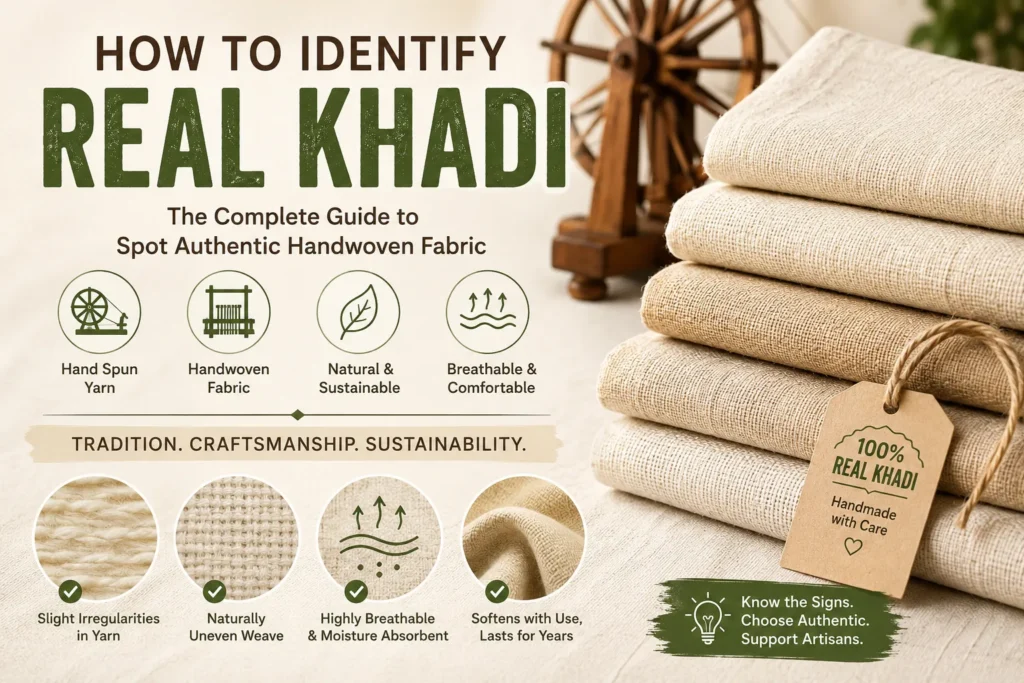
How can you identify real khadi? Authentic khadi is made from hand-spun yarn and handwoven fabric. It typically has slight irregularities in the yarn, a naturally uneven weave, excellent breathability, high moisture absorption, and a soft texture that improves with use. Reading product descriptions carefully, understanding fabric characteristics, and purchasing from trusted sellers can help you choose genuine khadi with confidence.
Knowing how to identify authentic khadi is important for more than avoiding fake products. Every purchase of genuine khadi supports skilled artisans who preserve India’s traditional weaving techniques. It also encourages sustainable fashion by promoting fabrics produced with minimal industrial processing and lower environmental impact.
In this guide, you’ll learn how real khadi is made, what makes it different from ordinary fabrics, how to recognise authentic khadi using practical identification methods, and how khadi compares with cotton. By the end of this article, you’ll have the knowledge to make informed purchasing decisions and appreciate the craftsmanship behind every piece of genuine khadi.
What Is Real Khadi?
Understanding what makes khadi unique is the first step in identifying authentic fabric. Many people assume that every handloom or cotton fabric is khadi, but this is one of the most common misconceptions. Genuine khadi follows a specific production process that distinguishes it from machine-made textiles and gives it the qualities for which it is widely respected.
How Khadi Is Made
Real khadi begins with natural fibres such as cotton, silk, or wool. Unlike conventional textiles, the yarn is first hand-spun, traditionally using a spinning wheel known as the charkha. This manual process creates yarn that naturally varies in thickness because every thread is spun by hand rather than by precision machinery.
Once the yarn is prepared, it is woven by skilled artisans on a handloom. Every movement of the loom is controlled manually, allowing craftsmen to create fabric without relying on industrial machines. This careful weaving process gives khadi its distinctive appearance and ensures that no two pieces of fabric are exactly alike.
The production of authentic khadi is time-intensive because every stage requires craftsmanship, patience, and attention to detail. From spinning the yarn to weaving the final fabric, artisans contribute their expertise to create textiles that combine tradition with quality.
This traditional manufacturing process also supports rural employment across India. Thousands of artisan families continue to preserve these skills, making every piece of genuine khadi a product of human craftsmanship rather than mass production.
According to the Khadi and Village Industries Commission (KVIC), authentic khadi is produced using hand-spun yarn and handwoven fabric. This traditional production process distinguishes genuine khadi from machine-made textiles and preserves India’s rich handloom heritage.
What Makes Real Khadi Unique
Authentic khadi has several characteristics that distinguish it from ordinary machine-made fabrics. The most noticeable feature is its natural texture. Since the yarn is hand-spun, the threads are not perfectly uniform, creating slight irregularities that give the fabric its authentic appearance. These variations are signs of craftsmanship rather than manufacturing defects.
Another defining quality is breathability. The handwoven structure allows better air circulation than many tightly woven machine-made fabrics. This helps regulate body temperature, keeping the wearer cool during hot weather and providing gentle insulation in cooler conditions. Because of this adaptability, khadi is often described as an all-season fabric.
Real khadi is also known for its excellent moisture absorption. It absorbs perspiration efficiently and allows it to evaporate quickly, making it comfortable for long hours of wear in warm and humid climates.
Unlike synthetic fabrics that often lose their appeal over time, authentic khadi becomes softer with every wash while maintaining its strength. This combination of durability and comfort makes it a preferred choice for people seeking clothing that lasts for years rather than seasons.
Types of Authentic Khadi
Khadi is available in several varieties, each designed to suit different climates, occasions, and personal preferences. Understanding these types helps buyers select the most suitable fabric while recognising authentic products.
Cotton Khadi is the most widely used variety. It is lightweight, breathable, and comfortable, making it ideal for everyday wear, office clothing, kurtas, shirts, sarees, and summer garments.
Silk Khadi combines hand-spun craftsmanship with the elegance of silk. It offers a soft sheen and luxurious texture, making it popular for festive wear, weddings, and formal occasions. Despite its refined appearance, it retains the handcrafted character of authentic khadi.
Wool Khadi is produced using hand-spun wool fibres. It provides natural warmth while remaining breathable, making it suitable for colder regions and winter clothing.
Some artisans also produce khadi blends, where natural fibres are combined to achieve specific textures or performance characteristics. When purchasing blended fabrics, buyers should always read the product description carefully to understand the fibre composition and ensure the fabric still follows authentic khadi production methods.
Regardless of the fibre used, genuine khadi always retains its defining characteristic: hand-spun yarn and handwoven construction. This traditional process is what separates authentic khadi from ordinary machine-made fabrics.
Why Identifying Real Khadi Matters
Choosing authentic khadi is about more than purchasing a piece of clothing. It is about recognising genuine craftsmanship, supporting traditional livelihoods, and investing in a fabric that offers lasting comfort and value. As demand for khadi grows, the market has also seen an increase in fabrics labelled as “khadi” despite being partially or completely machine-made. Understanding why authenticity matters helps you make smarter purchasing decisions and appreciate the true value of this handcrafted fabric.
Protect Yourself from Fake Products
One of the biggest reasons to learn how to identify real khadi is to avoid buying imitation products. Many fabrics available online and in retail stores are advertised as khadi because the name attracts customers looking for natural and sustainable clothing. However, some of these products are produced using machine-spun yarn or power looms, which means they do not meet the traditional characteristics of authentic khadi.
At first glance, fake khadi may appear similar to genuine fabric. The colour, design, and even the texture can look convincing in product photographs. However, once you wear or wash the garment, the differences often become noticeable. Machine-made fabrics usually have perfectly uniform yarn, a smooth weave, and may not provide the same breathability or comfort as authentic handwoven khadi.
Buying imitation khadi can also lead to disappointment in quality. Many buyers expect the softness, durability, and natural feel associated with authentic khadi but instead receive a fabric that behaves like ordinary cotton. Learning to recognise the signs of genuine khadi helps you avoid paying premium prices for products that do not deliver the expected quality.
Before making a purchase, take time to read the product description, examine close-up fabric images, and buy from sellers who clearly explain the fabric’s production process. A little research can save you from costly mistakes and help you invest in clothing that truly reflects the values of authentic khadi.
Support Indian Artisans
Every piece of authentic khadi represents hours of skilled manual work. From spinning the yarn to weaving the fabric, artisans use techniques that have been passed down through generations. These traditional skills are not only part of India’s cultural heritage but also provide employment and income for thousands of weaving families across the country.
When you purchase genuine khadi, you contribute to preserving these traditional crafts. Your purchase helps sustain rural livelihoods and encourages younger generations to continue practising weaving techniques that might otherwise disappear. In this way, buying authentic khadi is not simply a fashion choice—it is also an investment in India’s living textile heritage.
Supporting artisan-made products also encourages ethical production. Unlike mass-produced fabrics manufactured in large industrial facilities, authentic khadi is created through labour-intensive craftsmanship. This slower production process values quality over quantity and gives each fabric its unique identity.
By choosing authentic khadi instead of imitation products, you help ensure that the benefits of your purchase reach the communities responsible for creating these remarkable textiles.
India’s handloom sector plays an important role in preserving traditional craftsmanship while providing livelihoods to weaving communities across the country. The Ministry of Textiles continues to support initiatives that promote handloom development and traditional weaving practices.
Choose Sustainable Fashion
Sustainability has become an important factor when choosing clothing, and authentic khadi aligns naturally with many principles of responsible fashion. Its production process relies heavily on manual craftsmanship rather than energy-intensive industrial machinery, reducing the environmental impact associated with large-scale textile manufacturing.
Because khadi is made from natural fibres such as cotton, silk, or wool, it offers excellent breathability and comfort without depending on synthetic materials. High-quality khadi garments are also known for their durability, allowing them to be worn for many years with proper care. This reduces the need for frequent replacements and encourages a more thoughtful approach to clothing purchases.
Choosing authentic khadi also supports the philosophy of slow fashion. Instead of buying garments designed for short-term trends, you invest in clothing that values craftsmanship, longevity, and timeless style. This approach benefits both consumers and the environment by reducing waste and promoting mindful consumption.
When you understand how to identify real khadi, you are better equipped to choose products that match your values while enjoying a fabric celebrated for its comfort, heritage, and lasting quality.
How to Identify Real Khadi
Identifying authentic khadi becomes much easier when you know what to look for. Although no single characteristic can confirm authenticity on its own, examining several features together provides a reliable way to distinguish genuine khadi from machine-made alternatives. The following methods are practical, easy to understand, and useful whether you are shopping online or in person.
Examine the Fabric and Weave
The weave is one of the most reliable indicators of authentic khadi. Because the yarn is hand-spun and the fabric is handwoven, the weave usually contains small natural variations. These slight irregularities are created during the manual production process and are considered signs of authenticity rather than defects.
Look closely at the surface of the fabric. Authentic khadi often has subtle differences in thread thickness and spacing. Unlike machine-made textiles, where every thread appears perfectly identical, genuine khadi reflects the human touch behind its creation. These natural characteristics give each fabric its own personality and distinguish it from mass-produced materials.
Texture also provides valuable clues. Real khadi feels natural and breathable rather than overly smooth or synthetic. New garments may have a slightly crisp feel, but they gradually become softer after repeated washing and regular use without losing their strength.
Wrinkling is another characteristic worth observing. Since authentic khadi is made from natural fibres and woven by hand, it tends to develop soft, natural wrinkles during wear. These wrinkles are part of the fabric’s authentic appearance and should not be mistaken for poor quality.
If you have the opportunity to compare genuine khadi with machine-made cotton side by side, the handcrafted weave and natural texture become much easier to recognise.
Check Labels, Certification, and Price
Product information plays an important role in identifying authentic khadi, especially when shopping online. Reputable sellers usually provide clear details about the fabric, including the fibre used, production method, care instructions, and product origin. Transparent information allows buyers to understand exactly what they are purchasing.
Some authentic khadi products may also include recognised certifications or information about their production. While certification can increase buyer confidence, it should be considered alongside other characteristics such as weave, texture, and seller credibility. Authenticity is best confirmed through a combination of factors rather than relying on a single label.
Price can also offer useful clues, although it should never be treated as the only indicator. Producing genuine khadi requires skilled manual labour and considerable time, making it more expensive to manufacture than many machine-made fabrics. If a product advertised as authentic khadi is offered at an unusually low price compared with similar products, it is worth examining the description more carefully before making a purchase.
Buying from trusted brands with a reputation for quality and transparency significantly reduces the risk of purchasing imitation fabrics. Reading customer reviews, checking detailed photographs, and understanding the return policy are practical steps that help buyers shop with greater confidence.
Test Comfort, Breathability, and Durability
One of the easiest ways to appreciate authentic khadi is by wearing it. Genuine khadi is valued for its exceptional comfort because its handwoven structure allows air to circulate freely through the fabric. This natural breathability helps keep the body cool during hot weather while providing comfortable insulation in cooler temperatures.
Moisture absorption is another important characteristic. Authentic khadi absorbs perspiration efficiently and allows moisture to evaporate naturally, reducing discomfort during long hours of wear. This quality makes khadi particularly suitable for warm and humid climates.
Durability is equally impressive. Although the fabric may appear lightweight, high-quality khadi is designed to withstand regular use. With proper washing and care, it becomes softer over time without losing its strength or structure. Many khadi garments remain comfortable and attractive for years, making them a worthwhile long-term investment.
Instead of judging a garment solely by its appearance, consider how it performs during everyday use. Comfort, breathability, and lasting durability are among the strongest qualities that distinguish authentic khadi from many machine-made alternatives.
Khadi vs Cotton: How to Tell the Difference
Although many people use the terms khadi and cotton interchangeably, they are not the same. This is one of the biggest reasons buyers struggle to identify authentic khadi. Since cotton is the most common fibre used to produce khadi, it is easy to assume that every cotton fabric is khadi. In reality, khadi refers to the production process, while cotton refers to the fibre.
A fabric can be made from cotton without being khadi. Likewise, authentic khadi can be produced from cotton, silk, or wool, provided the yarn is hand-spun and the fabric is handwoven. Understanding this distinction is essential when shopping for authentic khadi because it helps you evaluate a fabric beyond its fibre content.
The following comparison explains the key differences between khadi and conventional cotton fabrics, helping you choose the right material based on your needs.
Manufacturing Process
The biggest difference between khadi and conventional cotton lies in how they are made. Authentic khadi follows a traditional production process where natural fibres are first spun into yarn by hand and then woven manually on a handloom. Every stage depends on skilled craftsmanship rather than industrial machinery, giving the fabric its unique appearance and character.
Most conventional cotton fabrics, on the other hand, are manufactured using automated spinning and weaving machines. Machine production creates highly uniform yarn and perfectly consistent weaves, allowing manufacturers to produce large quantities quickly and at lower costs. While this improves efficiency, it removes the natural variations that make authentic khadi distinctive.
Because khadi is handcrafted, every metre of fabric reflects the artisan’s skill. Slight variations in yarn thickness, weave density, and surface texture are normal and should be viewed as signs of authenticity rather than defects.
The manufacturing process also influences the overall experience of wearing the fabric. Hand-spun yarn creates tiny air pockets within the weave, contributing to the breathability and comfort for which authentic khadi is widely appreciated.
| Feature | Authentic Khadi | Conventional Cotton |
|---|---|---|
| Yarn Production | Hand-spun | Machine-spun |
| Weaving | Handwoven | Machine-woven |
| Texture | Naturally irregular | Uniform |
| Production Speed | Slow, artisan-based | Fast, industrial |
| Every Fabric Piece | Unique | Nearly identical |
These production differences explain why authentic khadi carries a unique identity that cannot be fully replicated through mass manufacturing.
Comfort, Texture, and Performance
Comfort is one of the main reasons people continue to choose authentic khadi. Its handwoven construction allows better air circulation, making it exceptionally breathable during warm weather. The fabric also absorbs moisture efficiently, helping the body stay comfortable throughout the day.
Conventional cotton fabrics can also be comfortable, especially those made from high-quality fibres. However, their tightly controlled machine weaving often creates a more uniform structure that behaves differently from handwoven khadi. Depending on the weave, some cotton fabrics may retain more heat or feel less airy than genuine khadi.
Texture provides another useful clue. Authentic khadi usually feels natural and slightly textured because of its hand-spun yarn. Machine-made cotton generally feels smoother and more consistent throughout the fabric. Neither texture is inherently better, but understanding the difference helps buyers recognise authentic craftsmanship.
Another advantage of genuine khadi is how it ages. Rather than wearing out quickly, quality khadi becomes softer with repeated washing while retaining its strength. This gradual improvement makes it a favourite among people who value long-lasting natural fabrics.
| Characteristic | Authentic Khadi | Conventional Cotton |
|---|---|---|
| Breathability | Excellent | Good |
| Moisture Absorption | Excellent | Good |
| Texture | Natural, slightly uneven | Smooth and uniform |
| Comfort in Summer | Excellent | Very Good |
| Softness Over Time | Improves with use | Depends on fabric quality |
These characteristics explain why many people prefer authentic khadi for everyday wear, particularly in warm and humid climates.
Sustainability and Durability
One of the greatest strengths of authentic khadi is its connection to sustainable fashion. Because much of the production process relies on manual craftsmanship instead of large-scale industrial machinery, it generally requires less energy during manufacturing. Every purchase also contributes to preserving traditional weaving skills and supporting artisan communities.
Conventional cotton production has evolved significantly over the years, and many manufacturers now adopt environmentally responsible practices. However, large-scale machine production typically involves higher energy consumption and mass manufacturing processes that differ from the slower, artisan-led approach used to create authentic khadi.
Durability is another area where genuine khadi performs exceptionally well. Although lightweight, well-made khadi garments are designed to withstand regular use. With proper care, they often become softer while maintaining their structural integrity for years. This long lifespan reduces the need for frequent replacement, making authentic khadi an attractive choice for people interested in building a more sustainable wardrobe.
Instead of focusing only on the initial purchase price, it is helpful to consider cost per wear. A garment that remains comfortable and durable for many years often provides better long-term value than clothing that needs replacing after a short period.
Choosing authentic khadi also supports the principles of slow fashion. Rather than encouraging frequent purchases driven by changing trends, it promotes thoughtful buying decisions based on quality, craftsmanship, and longevity.
Which Fabric Should You Choose?
There is no universal answer because both fabrics serve different purposes. The best choice depends on your lifestyle, climate, budget, and personal preferences.
If you prioritise handcrafted quality, breathability, and sustainable fashion, authentic khadi is an excellent choice. Its unique texture, comfortable feel, and artisan-made character make it ideal for people who appreciate traditional craftsmanship and timeless clothing.
Conventional cotton remains a practical option for buyers seeking affordable, widely available everyday garments. Modern cotton fabrics are available in many styles and finishes, making them suitable for casual wear, uniforms, and a variety of fashion needs.
The following recommendations can help you decide which fabric best matches your priorities.
| Your Priority | Recommended Fabric |
|---|---|
| Hot and humid weather | Authentic Khadi |
| Sustainable fashion | Authentic Khadi |
| Supporting traditional artisans | Authentic Khadi |
| Traditional or festive clothing | Authentic Khadi |
| Budget-friendly everyday basics | Cotton |
| Wide variety of styles | Cotton |
| Long-term wardrobe investment | Authentic Khadi |
Ultimately, neither fabric is universally better. Understanding how they are produced, how they perform, and what makes each unique allows you to make a choice that suits your needs.
If you would like a detailed comparison covering comfort, durability, maintenance, sustainability, and everyday use, explore our comprehensive guide on Khadi vs Cotton to gain a deeper understanding before making your next purchase.
How to Buy Authentic Khadi Online
Buying khadi online is convenient because it gives you access to a wide range of products from different brands and artisans. However, since you cannot touch or examine the fabric before purchasing, it is important to evaluate the information provided by the seller carefully. A few simple checks can help you identify authentic khadi and avoid disappointment.
Choose Trusted Sellers
The first step in buying authentic khadi online is choosing a seller with a reputation for quality and transparency. Established brands usually provide detailed information about their products, including fabric composition, weaving methods, care instructions, and high-quality images from different angles.
Before placing an order, spend a few minutes researching the brand. Read customer reviews, explore their website, and check whether they consistently describe their products accurately. Reliable sellers are generally open about their sourcing practices and explain what makes their khadi authentic.
Customer feedback can also provide valuable insights into fabric quality, sizing, colour accuracy, and overall satisfaction. While no brand receives perfect reviews, a consistent pattern of positive experiences is a good sign that the seller values quality and customer service.
If product descriptions are vague or essential information is missing, consider asking questions before purchasing. A trustworthy seller will usually be happy to provide additional details about the fabric and its production.
Read Product Information Carefully
A detailed product description is one of your best tools for identifying authentic khadi when shopping online. Instead of focusing only on colours or designs, pay attention to the fabric information provided by the seller.
Look for details such as the fibre used, whether the fabric is hand-spun and handwoven, garment care instructions, and close-up images that clearly show the texture of the fabric. Multiple product photographs taken under natural lighting often provide a better understanding of the weave than heavily edited marketing images.
It is also helpful to review the garment measurements carefully. Natural fabrics may behave differently depending on the weave, so checking the size guide before ordering can reduce the chances of needing an exchange.
Finally, read the return and exchange policy. A transparent policy gives buyers confidence and reflects the seller’s commitment to customer satisfaction.
Use a Smart Buying Checklist
Before completing your purchase, take a moment to go through a simple checklist. Spending a few extra minutes evaluating the product can help you avoid buying imitation fabrics.
Authentic Khadi Buying Checklist
| Checkpoint | What to Look For |
|---|---|
| Product description | Clearly explains the fabric and production process |
| Fabric images | Close-up photos showing texture and weave |
| Seller reputation | Positive customer reviews and transparent information |
| Fabric details | Fibre composition and care instructions |
| Price | Reasonable for handcrafted fabric—not unrealistically cheap |
| Return policy | Clearly explained and customer-friendly |
Following this checklist every time you shop online makes it much easier to identify authentic khadi and purchase with confidence.
Common Myths About Real Khadi
Despite its growing popularity, many misconceptions still surround khadi. These myths often confuse buyers and make it harder to recognise authentic fabric. Understanding the facts allows you to make informed decisions instead of relying on common assumptions.
Myth: All Handloom Fabric Is Khadi
This is one of the most widespread misconceptions. While authentic khadi is handwoven, not every handloom fabric qualifies as khadi.
The defining feature of genuine khadi is that the yarn is hand-spun before it is handwoven. Many handloom fabrics use machine-spun yarn that is woven manually on a handloom. Although these fabrics are handcrafted, they are not considered authentic khadi.
Understanding this distinction helps buyers appreciate why khadi has its own identity within India’s textile tradition.
Myth: Expensive Means Authentic
Many people assume that a higher price automatically guarantees authenticity. In reality, price alone cannot determine whether a fabric is genuine khadi.
Authentic khadi often costs more because of the time and craftsmanship involved in its production. However, premium pricing does not always mean a product has been made using traditional methods.
Instead of relying only on price, evaluate the product description, seller reputation, fabric characteristics, and overall transparency before making your decision.
Myth: Khadi and Cotton Are the Same
Although cotton is commonly used to produce khadi, the two terms do not have the same meaning.
Cotton refers to the natural fibre used to make fabric, whereas khadi refers to the traditional process of hand spinning and hand weaving. A cotton shirt is not automatically khadi, just as authentic khadi can also be made using silk or wool.
Understanding this difference helps buyers avoid confusion and choose fabrics that match their expectations.
How Khadigram Helps You Choose Authentic Khadi
Choosing authentic khadi should be a confident and informed experience. At Khadigram, our goal is to make that process easier by providing clear information, quality craftsmanship, and products that celebrate India’s rich textile heritage.
Our Commitment to Authentic Fabrics
Every khadi product deserves transparency. That’s why clear product descriptions, fabric details, and accurate images are essential in helping customers understand what they are buying.
Rather than relying on marketing claims alone, we believe buyers should have access to the information they need to make informed decisions. Educating customers about authentic khadi is just as important as offering quality products.
Designed for Comfort and Everyday Wear
Authentic khadi is appreciated not only for its heritage but also for its everyday comfort. Breathable fabrics, timeless designs, and thoughtful craftsmanship make khadi suitable for work, travel, festive occasions, and casual wear alike.
As the fabric becomes softer with regular use, it continues to provide comfort while maintaining its natural character.
Supporting Indian Craftsmanship
Behind every authentic khadi garment is the dedication of skilled artisans who continue to preserve traditional weaving techniques.
Choosing genuine khadi helps encourage these crafts and keeps India’s textile heritage alive for future generations. Every informed purchase contributes to sustaining the craftsmanship that makes khadi truly unique.
Frequently Asked Questions
1. What is real khadi?
Real khadi is fabric made from hand-spun yarn and handwoven cloth using natural fibres such as cotton, silk, or wool.
2. How can I identify authentic khadi?
Look for slight yarn irregularities, a natural texture, excellent breathability, moisture absorption, and detailed product information from trusted sellers.
3. Is all cotton fabric khadi?
No. Cotton is a fibre, while khadi refers to the traditional method of hand spinning and hand weaving.
4. Why is authentic khadi more expensive?
Because every stage of production requires skilled manual craftsmanship and takes significantly more time than machine manufacturing.
5. Does real khadi wrinkle easily?
Yes. Natural wrinkles are a normal characteristic of authentic khadi and reflect its handcrafted nature.
6. Can khadi be worn in summer?
Yes. Its excellent breathability and moisture absorption make it one of the most comfortable fabrics for warm weather.
7. Does khadi become softer over time?
Yes. High-quality khadi generally becomes softer with repeated washing while retaining its durability.
8. Is handloom fabric always khadi?
No. Handloom fabric can use machine-spun yarn. Authentic khadi requires both hand-spun yarn and handwoven construction.
9. Can khadi be worn throughout the year?
Yes. Its breathable structure helps regulate body temperature in different seasons.
10. Where can I buy authentic khadi online?
Purchase from trusted brands that provide transparent product descriptions, clear fabric details, and reliable customer support.
Conclusion
Authentic khadi is much more than a traditional Indian fabric. It represents skilled craftsmanship, sustainable production, and timeless comfort. Learning how to identify real khadi allows you to distinguish genuine hand-spun and handwoven fabric from machine-made alternatives, ensuring that every purchase reflects quality rather than marketing claims.
By examining the weave, understanding the production process, checking product information carefully, and buying from trusted sellers, you can make confident purchasing decisions. Understanding the difference between khadi and cotton also helps you choose the right fabric for your lifestyle while appreciating what makes authentic khadi unique.
Whether you’re shopping for everyday clothing, festive wear, or building a sustainable wardrobe, choosing genuine khadi supports traditional artisans and preserves one of India’s most valued textile traditions. With the knowledge you’ve gained from this guide, you can confidently recognise authentic khadi and enjoy the comfort, durability, and heritage that make it truly special.